The Nile on
Solving Direct and Inverse Heat Conduction Problems by Jan Taler, Piotr Duda
This book is devoted to the concept of simple and inverse heat conduction problems. the exact and approximate analytical methods and numerical methods, such as the finite difference method, the finite volume method, the finite element method and the boundary element method are discussed in great detail.
FORMAT
Hardcover LANGUAGE
English CONDITION
Brand New Publisher Description
This book is devoted to the concept of simple and inverse heat conduction problems. The process of solving direct problems is based on the tempera ture determination when initial and boundary conditions are known, while the solving of inverse problems is based on the search for boundary condi tions when temperature properties are known, provided that temperature is the function of time, at the selected inner points of a body. In the first part of the book (Chaps. 1-5), we have discussed theoretical basis for thermal conduction in solids, motionless liquids and liquids that move in time. In the second part of the book, (Chapters 6-26), we have discussed at great length different engineering problems, which we have presented together with the proposed solutions in the form of theoretical and mathematical examples. It was our intention to acquaint the reader in a step-by-step fashion with all the mathematical derivations and solutions to some of the more significant transient and steady-state heat conduction problems with respect to both, the movable and immovable heat sources and the phenomena of melting and freezing. Lots of attention was paid to non-linear problems. The methods for solving heat conduction problems, i. e. the exact and approximate analytical methods and numerical methods, such as the finite difference method, the finite volume method, the finite element method and the boundary element method are discussed in great detail. Aside from algorithms, applicable computational programs, written in a FORTRAN language, were given.
Notes
Presents the theoretical basis for thermal conduction in solids, motionless liquids and liquids that move
Includes a multitude of solved examples and solutions of engineering heat conduction problems, for example during the designing and life-time calculations of industrial machinery, combustion engines and in refrigerating and air conditioning engineering
User-oriented written, easy to follow
Makes the reader in a step-by-step fashion acquainted with all the mathematical derivations and solutions to the significant transient and steady-state heat conduction problems
Accompanying CD-Rom includes computational solutions of the examples/FORTRAN codes
Back Cover
The book presents a solution for direct and inverse heat conduction problems. In the first part, the authors discuss the theoretical basis for the heat transfer process. In the second part, they present selected theoretical and numerical problems in the form of exercises with their subsequent solutions. Such layout of the book will allow the reader to become more familiar with step-by-step calculation methods and with the practical application of the equations to the solution of design and utilization problems of thermal machinery. It will also help to master complex mathematics behind the heat transfer theory. The book covers one-, two- and three dimensional problems which are solved by using exact and approximate analytical methods and numerical methods such as: the finite difference method, the finite volume method, the finite element method and the boundary method. Unlike other books on the subject, the superposition method is thoroughly presented. Particular attention is paid to the solution of inverse heat conduction problems. The authors took special care that the solved inverse problems can be implemented in indirect measurements of boundary heat flux and heat transfer coefficient. Included in this text is the determination of optimal fluid temperature changes during heating and cooling of solids. In great detail the problems of temperature transients caused by both moveable and immovable heat sources is discussed. They analyze the melting and freezing processes, including the freezing of food products. Moreover, they use computing programs written in Fortran language for solving mathematical equations. The book content is strengthened by additional materials presented at the back of the book, which include, among others, the description of basic mathematical functions characteristic of heat transfer problems, calculation of the inverse Laplace transformation, the property tables for stable thermophysical bodies and shape coefficients for isothermal surfaces of various shapes and programs that are typically used for solving differential equations. This book is strongly recommended for undergraduate and PhD students, researchers and academics of Power, Process, Mechanical and Environmental Engineering Faculties. The book should also appeal to those who conduct research in the area of thermal engineering, house-heating, air-conditioning systems and cooling processes, combustion engines and welding technology.
Table of Contents
Heat Conduction Fundamentals.- Fourier Law.- Mass and Energy Balance Equations.- The Reduction of Transient Heat Conduction Equations and Boundary Conditions.- Substituting Heat Conduction Equation by Two-Equations System.- Variable Change.- Exercises. Solving Heat Conduction Problems.- Heat Transfer Fundamentals.- Two-Dimensional Steady-State Heat Conduction. Analytical Solutions.- Analytical Approximation Methods. Integral Heat Balance Method.- Two-Dimensional Steady-State Heat Conduction. Graphical Method.- Two-Dimensional Steady-State Problems. The Shape Coefficient.- Solving Steady-State Heat Conduction Problems by Means of Numerical Methods.- Finite Element Balance Method and Boundary Element Method.- Transient Heat Exchange between a Body with Lumped Thermal Capacity and Its Surroundings.- Transient Heat Conduction in Half-Space.- Transient Heat Conduction in Simple-Shape Elements.- Superposition Method in One-Dimensional Transient Heat Conduction Problems.- Transient Heat Conduction in a Semi-Infinite Body. The Inverse Problem.- Inverse Transient Heat Conduction Problems.- Multidimensional Problems. The Superposition Method.- Approximate Analytical Methods for Solving Transient Heat Conduction Problems.- Finite Difference Method.- Solving Transient Heat Conduction Problems by Means of Finite Element Method (FEM).- Numerical-Analytical Methods.- Solving Inverse Heat Conduction Problems by Means of Numerical Methods.- Heat Sources.- Melting and Solidification (Freezing).
Review
From the reviews:"The present book is devoted to direct and inverse heat conduction problems. … The methods for solving problems involved with welding and laser technology are also discussed in great detail. The present book is addressed to undergraduate and PhD students of mechanical, power, process and environment engineering. … it can also serve as a reference book to be used by nuclear, industrial and civil engineers." (Lubomira Softova, Zentralblatt MATH, Vol. 1122 (24), 2007)
Long Description
This book is devoted to the concept of simple and inverse heat conduction problems. The process of solving direct problems is based on the tempera
Review Quote
From the reviews:"The present book is devoted to direct and inverse heat conduction problems. … The methods for solving problems involved with welding and laser technology are also discussed in great detail. The present book is addressed to undergraduate and PhD students of mechanical, power, process and environment engineering. … it can also serve as a reference book to be used by nuclear, industrial and civil engineers." (Lubomira Softova, Zentralblatt MATH, Vol. 1122 (24), 2007)
Feature
Presents the theoretical basis for thermal conduction in solids, motionless liquids and liquids that move Includes a multitude of solved examples and solutions of engineering heat conduction problems, for example during the designing and life-time calculations of industrial machinery, combustion engines and in refrigerating and air conditioning engineering User-oriented written, easy to follow Makes the reader in a step-by-step fashion acquainted with all the mathematical derivations and solutions to the significant transient and steady-state heat conduction problems Accompanying CD-Rom includes computational solutions of the examples/FORTRAN codes
Details ISBN354033470X Author Piotr Duda Short Title SOLVING DIRECT & INVERSE HEAT Language English ISBN-10 354033470X ISBN-13 9783540334705 Media Book Format Hardcover Year 2006 Imprint Springer-Verlag Berlin and Heidelberg GmbH & Co. K Place of Publication Berlin Country of Publication Germany DEWEY 536.23 Edition 2006th DOI Pages 889 Publisher Springer-Verlag Berlin and Heidelberg GmbH & Co. KG Edition Description 2006 ed. Publication Date 2006-10-18 Audience Professional & Vocational Illustrations XXVI, 889 p. Country of Origin DE Product Class Description Mechanical Engineering Alternative 9783540334712
We\'ve got this
At The Nile, if you\'re looking for it, we\'ve got it.
With fast shipping, low prices, friendly service and well over a million items - you\'re bound to find what you want, at a price you\'ll love!
TheNile_Item_ID:96272687;
When you click on links to various merchants on this site and make a purchase, this can result in this site earning a commission. Affiliate programs and affiliations include, but are not limited to, the eBay Partner Network.

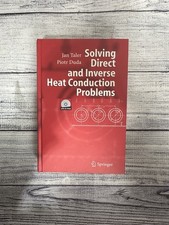 Solving Direct and Inverse Heat Conduction Problems by Jan Taler (English) Hardc$63.75
 Solving Direct and Inverse Heat Conduction Problems by Jan Taler (English) Paper$252.75
 Solving Direct and Inverse Heat Conduction Problems by Jan Taler (English) Hardc$252.75
 Solving Direct and Inverse Heat Conduction Problems.by Taler, Duda New<| $277.82
 Taler - Solving Direct and Inverse Heat Conduction Problems - New hard - X555z$322.51
 Taler - Solving Direct and Inverse Heat Conduction Problems - hardback - R843z$226.67
 Solving Direct and Inverse Heat Conduction Problems by Jan Taler: New$242.14
 www.userbars.org














