The Nile on
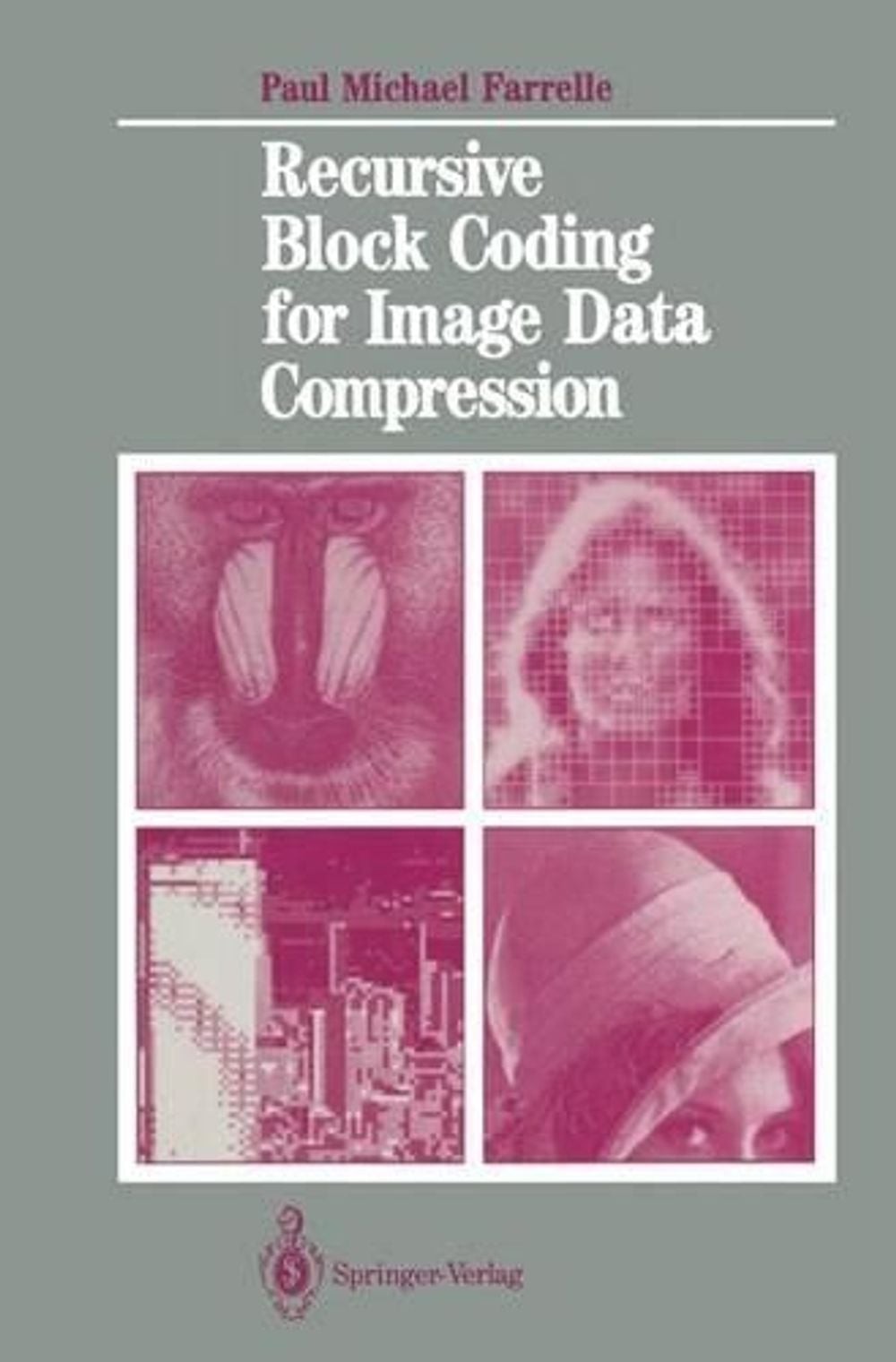
Recursive Block Coding for Image Data Compression by Paul M. Farrelle
Recursive Block Coding, a new image data compression technique that has its roots in noncausal models for 1d and 2d signals, is the subject of this book.
FORMAT
Paperback LANGUAGE
English CONDITION
Brand New Publisher Description
Recursive Block Coding, a new image data compression technique that has its roots in noncausal models for 1d and 2d signals, is the subject of this book. The underlying theory provides a multitude of compression algorithms that encompass two course coding, quad tree coding, hybrid coding and so on. Since the noncausal models provide a fundamentally different image representation, they lead to new approaches to many existing algorithms, including useful approaches for asymmetric, progressive, and adaptive coding techniques. On the theoretical front, the basic result shows that a random field (an ensemble of images) can be coded block by block such that the interblock redundancy can be completely removed while the individual blocks are transform coded. On the practical side, the artifact of tiling, a block boundary effect, present in conventional block by block transform coding techniques has been greatly suppressed. This book contains not only a theoretical discussion of the algorithms but also exhaustive simulation and suggested methodologies for ensemble design techniques. Each of the resulting algorithms has been applied to twelve images over a wide range of image data rates and the results are reported using subjective descriptions, photographs, mathematical MSE values, and h-plots, a recently proposed graphical representation showing a high level of agreement with image quality as judged subjectively.
Notes
This book introduces a new image data compression technique called Recursive Block Coding. The book contains not only theoretical discussion but also simulation studies and suggested design methodologies.
Table of Contents
1 Introduction.- 1.1 The Need for Data Compression.- 1.2 Data Compression Techniques.- 1.3 The Problem—the Tile Effect.- 1.4 Our Approach—Two Source Decomposition.- 1.5 Organization.- 2 RBC—The Theory behind the Algorithms.- 2.1 Introduction.- 2.2 Modeling.- 2.3 Autoregressive Models.- 2.4 Noncausal Models.- 2.5 Two Source Decomposition.- 2.6 The 1d RBC Algorithm.- 2.7 Boundary Response for First Order AR Models.- 2.8 2d Minimum Variance Models.- 2.9 Examples of 2d Noncausal Image Models.- 2.10 2d Boundary Response via Transform Methods.- 2.11 The 2d RBC Algorithm.- 2.12 Approximate Boundary Response.- 2.13 Advantages of RBC.- 3 Bit Allocation and Quantization for Transform Coding.- 3.1 Introduction.- 3.2 Choice of Transform and Quantizer.- 3.3 Bit Allocation.- 3.4 Integer Bit Allocation.- 3.5 Zero Level Quantizers.- 3.6 Choice of RD Function for Bit Allocation.- 3.7 RBC Rate Distortion Analysis.- 3.8 Ensemble Design for DCT and RBC.- 3.9 Color Coding.- 4 Zonal Coding.- 4.1 Introduction.- 4.2 Original Images.- 4.3 Simulation Facilities.- 4.4 Image Quality Measures.- 4.5 1d Coding Results.- 4.6 2d Coding Results.- 4.7 Hybrid Coding.- 4.8 Conclusions.- 5 Adaptive Coding Based on Activity Classes.- 5.1 Introduction.- 5.2 Adaptive DCT.- 5.3 Adaptive RBC.- 5.4 Coding Results.- 5.5 Conclusions.- 6 Adaptive Coding Based on Quad Tree Segmentation.- 6.1 Introduction.- 6.2 Adaptive Segmentation.- 6.3 The Quad Tree Approach.- 6.4 Coding the Segmentation.- 6.5 Reconstruction.- 6.6 Coding the Residual.- 6.7 Results.- 6.8 Conclusions.- 7 QVQ—Vector Quantization of the Quad Tree Residual.- 7.1 Introduction.- 7.2 Vector Quantization.- 7.3 Differential and Interpolate VQ.- 7.4 VQ of the Quad Tree Residual.- 7.5 Coding Results.- 7.6 Conclusions.- 8 Conclusions.- 8.1Introduction.- 8.2 New Results.- 8.3 Coding Recommendations.- 8.4 Future Work.- Appendix A Ordinary and Partial Differential and Difference Equations.- A.1 Introduction.- A.2 Second Order Ordinary Differential Equations.- A.3 Second Order Ordinary Difference Equations.- A.4 Second Order Partial Differential Equations.- A.5 Second Order Partial Difference Equations.- Appendix B Properties of the Discrete Sine Transform.- B.1 Introduction.- Definition.- Notation.- Tridiagonal Toeplitz Matrices.- B.2 DST Evaluation Technique.- B.3 Exponential Sequences.- B.4 Constant Sequences.- B.5 Linear Sequences.- B.6 Hyperbolic Sequences.- B.7 Sinusoidal Sequences.- Appendix C Transform Domain Variance Distributions.- C.1 Introduction.- C.2 1d RBC.- Normalized Variance Distribution.- Variance Reduction Ratio.- C.3 1d DCT.- Appendix D Coding Parameters for Adaptive Coding Based on Activity Classes.- D.1 Introduction.- D.2 Adaptive DCT Coding Parameters.- D.3 Adaptive RBC Coding Parameters.- References.
Promotional
Springer Book Archives
Long Description
Recursive Block Coding, a new image data compression technique that has its roots in noncausal models for 1d and 2d signals, is the subject of this book. The underlying theory provides a multitude of compression algorithms that encompass two course coding, quad tree coding, hybrid coding and so on. Since the noncausal models provide a fundamentally different image representation, they lead to new approaches to many existing algorithms, including useful approaches for asymmetric, progressive, and adaptive coding techniques. On the theoretical front, the basic result shows that a random field (an ensemble of images) can be coded block by block such that the interblock redundancy can be completely removed while the individual blocks are transform coded. On the practical side, the artifact of tiling, a block boundary effect, present in conventional block by block transform coding techniques has been greatly suppressed. This book contains not only a theoretical discussion of the algorithms but also exhaustive simulation and suggested methodologies for ensemble design techniques. Each of the resulting algorithms has been applied to twelve images over a wide range of image data rates and the results are reported using subjective descriptions, photographs, mathematical MSE values, and h-plots, a recently proposed graphical representation showing a high level of agreement with image quality as judged subjectively.
Description for Sales People
This book introduces a new image data compression technique called Recursive Block Coding. The book contains not only theoretical discussion but also simulation studies and suggested design methodologies.
Details ISBN1461396786 Author Paul M. Farrelle Short Title RECURSIVE BLOCK CODING FOR IMA Language English ISBN-10 1461396786 ISBN-13 9781461396789 Media Book Format Paperback Pages 297 Year 2011 Publication Date 2011-12-01 Imprint Springer-Verlag New York Inc. Place of Publication New York, NY Country of Publication United States Illustrations XXVIII, 297 p. DOI 10.1007/978-1-4613-9676-5 AU Release Date 2011-12-01 NZ Release Date 2011-12-01 US Release Date 2011-12-01 UK Release Date 2011-12-01 Publisher Springer-Verlag New York Inc. Edition Description Softcover reprint of the original 1st ed. 1990 Alternative 9780387972350 DEWEY 006.42 Audience Professional & Vocational Country of Origin NL Product Class Description Computing: Professional & Programming
We\'ve got this
At The Nile, if you\'re looking for it, we\'ve got it.
With fast shipping, low prices, friendly service and well over a million items - you\'re bound to find what you want, at a price you\'ll love!
TheNile_Item_ID:96327289;
When you click on links to various merchants on this site and make a purchase, this can result in this site earning a commission. Affiliate programs and affiliations include, but are not limited to, the eBay Partner Network.

 Recursive Block Coding for Image Data Compression, Paperback by Farrelle, Pau...$120.84
 Recursive Block Coding for Image Data Compression by Paul M. ... - 9781461396789$103.33
 Recursive Block Coding for Image Data Compression by Paul M. Farrelle (English)$139.27
 Farrelle - Recursive Block Coding for Image Data Compression - New pap - X555z$130.12
 www.userbars.org