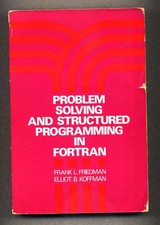
Problem Solving and Structured Programming in Fortran by Frank L. Friedman and Elliot B. Koffman
Publisher: Addison Wesley
Year: 1977
ISBN: 0201019671
Description: Trade Paperback, Good condition,
Condition: Previous owner\'s name, no underlining, no highlighting, small cover tears and creases
Pages: 404 page plus appendices and index
PREFACE
This book is designed as a text for a one-semester, introductory course in computer programming. No background other than high-school algebra is assumed. The material presented reflects the authors\' view that good problem-solving and programming habits should be introduced at a very early stage in the development of a student\'s programming skills, and that they are best instilled by examples, by frequent practice, and through instructor—student interaction. Therefore we have concentrated on demonstrating problem-solving and programming techniques through the use of approximately two dozen completely solved problems.
Discipline and planning in both problem solving and programming are illustrated in the text from the beginning. We have attempted to integrate a number of relatively new pedagogic ideas into a unique, well-structured format that is uniformly repeated for each problem discussed. Three basic phases of problem solving are emphasized: the analysis of the problem; the stepwise specification of the algorithm (using flow diagrams); and finally, the language implementation of the program.
Our goal is to bridge the gap between textbooks that stress problem-solving approaches divorced from implementation and language considerations and programming manuals that provide the opposite emphasis. Language-independent - problem analysis and algorithms are described in the same text as the language features required to implement the problem solution on the computer. For each new problem introduced in the text, the problem analysis and algorithm description are presented along with the complete syntactic and semantic definitions of the new language features convenient for the implementation of the algorithm.
...
CONTENTS
1
INTRODUCTION
1
1.1 Computer organization / 2 ■ 1.2 Programs and programming / 8 ■ 1.3 Introduction to FORTRAN and the fundamental computer operations / 13 ■ 1A1.1ing the computer / 27 ■ 1.5 Summary / 34 ■ Programming problems / 36
2
PROBLEM SOLVING
WITH THE COMPUTER
39
2.1 Problem analysis / 40 ■ 2.2 Description of the problem solution / 42 ■ 2.3 Algorithms involving transfers and loops / 47 ■ 2.4 Implementing a flow diagram in FORTRAN / 59 ■ 2.5 Debugging a FORTRAN program / 64 ■ 2.6 Summary and review / 65 ■ Programming problems / 67
3
BASIC CONTROL STRUCTURES
69
3.1 Introduction to control structures / 70 ■ 3.2 Decision structures / 72 ■ 3.3 The WHILE loop structure / 82 ■ 3.4 Reminders for algorithm development- using the WHILE loop / 94 ■ 3.5 The Widget inventory-control problem / 96 • 3.6 Common programming errors / 100 ■ 3.7 Summary: Control structures and structure in programs / 101 ■ Programming problems / 104
4
DATA TYPES-
THEIR USE AND MANIPULATION
109
4.1 Introduction / 110 ■ 4.2 Data types, declarations, and constants / 110 ■ 4.3 Format-free input/output statements / 119 ■ 4.4 Manipulation of character strings and logical data / 123 ■ 4.5 Integers and the indexed-DO. loop struc- • ture / 129 ■ 4.6 Arithmetic expressions / 137 ■ 4.7 Library functions / 145 ■ *4.8 Numerical errors / 151 ■ 4.9 Common programming errors / 153 ■ 4.10 Summary / 155 ■ Programming problems / 156
5
ARRAYS AND SUBSCRIPTS
161
5.1 Introduction / 162 ■ 5.2 Declaring arrays / 162 ■ 5.3 Array subscripts / 164 • 5.4 Manipulating arrays / 166 • *5.5 Role of the translator in processing arrays / 176 ■ 5.6 Searching an array / 177 ■ 5.7 Processing selected array elements / 180 ■ 5.8 Common programming errors /;185 ■ 5.9 Summary / 186 ■ Programming problems / 187
6
ADVANCED CONTROL STRUCTURES 193
6.1 Introduction / 194 ■ 6.2 The multiple-alternative decision structure / 194 ■ 6.3 The bowling problem / 200 ■ 6.4 The indexed-DO and the FOR loop / 204 • 6.5 Using structures : Part I-Structure nesting / 210 ■ 6.6 Using structures: Part II-Structure entry and transfers / 221 ■ 6.7 Remote blocks and top-down, programming / 224 ■ 6.8 Common programming errors / 227 ■ 6.9 Summary / 229 ■ Programming problems / 230
7
SUBPROGRAMS
237
7.1 Introduction / 238 • 7.2 The program system charts / 238 ■ 7.3 Function subprograms / 240 ■ 7.4 Argument list correspondence / 246 ■ 7.5 Top-downprogramming—The relationship between main program and subprograms / 248 ■ 7.6 Subroutine subprograms / 252 ■ 7.7 Name independence: Subprograms and remote blocks / 258 ■ 7.8 Common blocks / 261 • 7.9 Additional comments concerning subprograms / 269 ■ *7.10 The role of the compiler in processing subprograms / 271 • 7.11 Common programming errors / 276 ■ 7.12 Summary / 277 ■ Programming problems / 278
8
FORMATTED
INPUT AND OUTPUT
287
8.1 Limitations of format-free input and output / 288 ■ 8.2 The format statement: A general discussion / 288 ■ 8.3 Format descriptors / 290 ■ 8.4 Common programming errors / 311 ■ 8.5 Summary / 312 ■ Programming problems / 313
9
USING LOGICAL AND
CHARACTER-STRING DATA
321
9.1 Introduction / 322 ■ 9.2 Logical expressions / 322 ■ 9.3 Character-string manipulation / 329 ■ 9.4 Character manipulation—Sample programs / 338 ■ 9.5 Common programming errors / 352 ■ 9.6 Summary / 353 ■ Programming prob7 lems / 353
10
MULTIDIMENSIONAL ARRAYS
363
10.1 Introduction / 364 ■ 10.2 Declaration of multidimensional arrays / 364 • 10.3 Manipulation of multidimensional arrays / 365 ■ *10A Compiler role for multidimensional arrays / 376 ■ 10.5 Multidimensional arrays as subprogram arguments / 376 ■ 10.6 Applications of multidimensional arrays / 378 ■ 10.7 Common programming errors / 399 ■ 10.8 Summary / 400 ■ Programming problems / 400
APPENDIX
THE MANIPULATION OF CHARACTER-TYPE DATA
Al
A.1 Introduction / Al ■ A.2 The length of character-string entities / A2 ■ A.3 Character substrings / A2 ■ A.4 The concatenation operator / A5 ■ A.5 Use of character expressions / A6 ■ A.6 \'The character-string length function—LEN / All ■ A.7 Character manipulation—Sample problems / Al2 ■ A.8 Common programming errors / A25 ■ Programming problems / A25
GLOSSARY
FORTRAN STATEMENTS
AND STRUCTURES
A27
ANSWERS
ANS-1
INDEX
I-1
nthdegree books
When you click on links to various merchants on this site and make a purchase, this can result in this site earning a commission. Affiliate programs and affiliations include, but are not limited to, the eBay Partner Network.

 Friedman Koffman Problem Solving Structured Programming FORTRAN 1979$9.00
 Problem Solving and Structured Programming in Pascal by Elliot B. Koffman$60.00
 Friedman Koffman Problem Solving Structured Programming FORTRAN 1981 2nd Ed$11.98
 Problem Solving and Structured Programming in Fortran, Frank L. Friedman et Elli$22.17
 Problem Solving and Structured Programming in Fortran - Friedman & Koffman$9.95
 Problem Solving & Structured Programming in Fortran 1981 Vintage Computer Book$19.99
 Techniques of Structured Problem Solving Hardcover Arthur B. Van$8.02
 Techniques of Structured Problem Solving Hardcover Arthur B. Van$8.02
 www.userbars.org