|
>> If you dont know how to design a userbar, then write here a Userbar that you want.
>> If you know how to design them help these people and design what they request.
|
 |
|
USERBARS.org | Free Forum Userbars
| On eBay now |

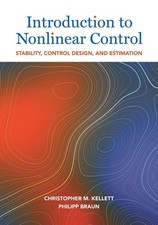
Introduction to Nonlinear Control: Stability, Control Design, and Estimation by
$77.05

The Nile on Introduction to Nonlinear Control by Christopher M. Kellett, Philipp Braun An introductory text on the analysis, control, and estimation of nonlinear systems, appropriate for advanced undergraduate and graduate students
This self-contained and accessible introduction to the concepts and techniques used for nonlinear response systems offers a holistic treatment suitable for use in both advanced undergraduate and graduate courses; students need only some familiarity with differential equations and linear algebra to understand the material presented. The text begins with an overview of stability and Lyapunov methods for nonlinear systems, with Lyapunov's second method revisited throughout the book as a connective thread. Other introductory chapters cover linear systems, frequency domain methods, and discrete-time systems. Building on this background material, the book provides a broad introduction to the basic ideas underpinning major themes of research in nonlinear control, including input-to-state stability, sliding mode control, adaptive control, response linearization, and robust output regulation. Chapters also cover observer design and estimation for nonlinear systems. The text is notable for its coverage of nonlinear model predictive control and its introduction to the use of linear matrix inequalities and semidefinite programming coupled with their use in modern antiwindup designs.
• First text on nonlinear control appropriate for undergraduates
• Suitable both for students preparing for rigorous graduate study and for those entering technical fields outside of academia
• Unique in its coverage of recent research topics
• Pedagogical features including extensive chapter summaries, examples, and appendixes with definitions, results, and MATLAB applications FORMAT Hardcover CONDITION Brand New Table of Contents Dynamical Systems - 1 Nonlinear Systems—Fundamentals and Examples
- 1.1 State Space Models
- 1.1.1 Notational Conventions
- 1.1.2 Rescaling
- 1.1.3 Comparison Functions
- 1.2 Control Loops, Controller Design, and Examples
- 1.2.1 The Pendulum on a Cart
- 1.2.2 Mobile Robots—The Nonholonomic Integrator
- 1.3 Exercises
- 1.4 Bibliographical Notes and Further Reading
- 2 Nonlinear Systems—Stability Notions
- 2.1 Stability Notions
- 2.1.1 Local versus Global Properties
- 2.1.2 Time-Varying Systems
- 2.2 Comparison Principle
- 2.3 Stability by Lyapunov's Second Method
- 2.3.1 Time-Varying Systems
- 2.3.2 Instability
- 2.3.3 Partial Convergence and the LaSalle-Yoshizawa Theorem
- 2.4 Region of Attraction
- 2.5 Converse Theorems
- 2.6 Invariance Theorems
- 2.6.1 Krasovskii-LaSalle Invariance Theorem
- 2.6.2 Matrosov's Theorem
- 2.7 Exercises
- 2.8 Bibliographical Notes and Further Reading
- 3 Linear Systems and Linearization
- 3.1 Linear Systems Review
- 3.1.1 Stability Properties for Linear Systems
- 3.1.2 Quadratic Lyapunov Functions
- 3.2 Linearization
- 3.3 Time-Varying Systems
- 3.4 Numerical calculation of Lyapunov functions
- 3.4.1 Linear Matrix Inequalities and Semidefinite Programming
- 3.4.2 Global Lyapunov Functions for Polynomial Systems
- 3.4.3 Local Lyapunov Functions for Polynomial Systems
- 3.4.4 Estimation of the Region of Attraction
- 3.5 Systems with Inputs
- 3.5.1 Controllability and Observability
- 3.5.2 Stabilizability and Detectability
- 3.5.3 Pole Placement
- 3.6 Exercises
- 3.7 Bibliographical Notes and Further Reading
- 4 Frequency Domain Analysis
- 4.1 Fundamental Results in the Frequency Domain
- 4.1.1 The Laplace Transform
- 4.1.2 The Transfer Function
- 4.1.3 The '2-, '∞- and ∞-norm
- 4.2 Stability Analysis in the Frequency Domain
- 4.2.1 Bounded-Input, Bounded-Output Stability
- 4.2.2 System Interconnections in the Frequency Domain
- 4.2.3 The Bode Plot
- 4.2.4 The Nyquist Criterion
- 4.3 Exercises
- 4.4 Bibliographical Notes and Further Reading
- 5 Discrete Time Systems
- 5.1 Discrete Time Systems—Fundamentals
- 5.2 Sampling: From Continuous to Discrete Time
- 5.2.1 Discretization of Linear Systems
- 5.2.2 Higher Order Discretization Schemes
- 5.3 Stability Notions
- 5.3.1 Lyapunov Characterizations
- 5.3.2 Linear Systems
- 5.3.3 Stability Preservation of Discretized Systems
- 5.4 Controllability and Observability
- 5.5 Exercises
- 5.6 Bibliographical Notes and Further Reading
- 6 Absolute Stability
- 6.1 A Commonly Ignored Design Issue
- 6.2 Historical Perspective on the Lur'e Problem
- 6.3 Sufficient Conditions for Absolute Stability
- 6.3.1 Circle Criterion
- 6.3.2 Popov Criterion
- 6.3.3 Circle versus Popov Criterion
- 6.4 Exercises
- 6.5 Bibliographical Notes and Further Reading
- 7 Input-to-State Stability
- 7.1 Motivation and Definition
- 7.2 Lyapunov Characterizations
- 7.3 System Interconnections
- 7.3.1 Cascade Connections
- 7.3.2 response Interconnections
- 7.4 Integral-to-Integral Estimates and '2-Gain
- 7.4.1 System interconnections
- 7.5 Integral ISS and Nonlinear '2-Gain
- 7.6 Dissipativity and Passivity
- 7.7 Exercises
- 7.8 Bibliographical Notes and Further Reading
II Controller Design- 8 LMI-Based Controller and Antiwindup Designs
- 8.1 '2-Gain Optimization for Linear Systems
- 8.1.1 Asymptotic Stability and '2-Gain Optimization
- 8.1.2 response Synthesis
- 8.2 Systems with Saturation
- 8.2.1 LMI-Based Saturated Linear State response Design
- 8.2.2 Global Asymptotic Stability Analysis
- 8.2.3'2-Stability and '2-Gain Optimization
- 8.3 Regional Analysis
- 8.3.1 Local Asymptotic Stability
- 8.3.2'2-Stability and '2-Gain Optimization
- 8.4 Antiwindup Synthesis
- 8.4.1 Global Antiwindup Synthesis
- 8.4.2 Well-Posedness of the Control Law
- 8.4.3 Regional Antiwindup Synthesis
- 8.5 Exercises
- 8.6 Bibliographical Notes and Further Reading
- 9 Control Lyapunov Functions
- 9.1 Control Affine Systems
- 9.2 ISS Redesign via LgV Damping
- 9.3 Sontag's Universal Formula
- 9.4 Backstepping
- 9.4.1 Avoiding Cancellations
- 9.4.2 Exact Backstepping and a High-Gain Alternative
- 9.4.3 Convergence Structure
- 9.5 Forwarding
- 9.5.1 Forwarding mod LgV
- 9.5.2 Convergence Structure
- 9.5.3 Saturated Control
- 9.6 Stabilizability and Control Lyapunov Functions
- 9.6.1 Existence of Lipschitz Continuous response Laws
- 9.6.2 Nonsmooth Control Lyapunov Functions
- 9.6.3 Robustness and Discontinuous response Laws
- 9.7 Exercises
- 9.8 Bibliographical Notes and Further Reading
- 10 Sliding Mode Control
- 10.1 Finite-Time Stability
- 10.2 Basic Sliding Mode Control
- 10.2.1 Terminology
- 10.2.2 Chattering and Chattering Avoidance
- 10.3 A More General Structure
- 10.4 Estimating the Disturbance
- 10.5 Output Tracking
- 10.6 Exercises
- 10.7 Bibliographical Notes and Further Reading
- 11 Adaptive Control
- 11.1 Motivating Examples and Challenges
- 11.1.1 Limitations of Static response Laws
- 11.1.2 Estimation-Based Controller Designs
- 11.2 Model Reference Adaptive Control
- 11.3 Adaptive Control for Nonlinear Systems
- 11.3.1 Adaptive Backstepping
- 11.3.2 Tuning Function Designs
- 11.3.3 Application: Single Link Manipulator with Flexible Joint
- 11.4 Exercises
- 11.5 Bibliographical Notes and Further Reading
- 12 Introduction to Differential Geometric Methods
- 12.1 Introductory Examples
- 12.2 Zero Dynamics and Relative Degree
- 12.3 response Linearization
- 12.3.1 Nonlinear Controllability
- 12.3.2 Input-to-State Linearization
- 12.4 Exercises
- 12.5 Bibliographical Notes and Further Reading
- 13 Output Regulation
- 13.1 Linear Output Regulation
- 13.2 Robust Linear Output Regulation
- 13.3 Nonlinear Output Regulation
- 13.4 Exercises
- 13.5 Bibliographical Notes and Further Reading
- 14 Optimal Control
- 14.1 Optimal Control—Continuous Time Setting
- 14.1.1 Linear Quadratic Regulator
- 14.1.2 Control-Affine Nonlinear Systems
- 14.1.3 Inverse Optimality
- 14.2 Optimal Control—Discrete Time Setting
- 14.2.1 Definitions and Notations
- 14.2.2 The Linear Quadratic Regulator
- 14.3 From Infinite- to Finite-Dimensional Optimization
- 14.3.1 The Principle of Optimality
- 14.3.2 Constrained Optimal Control for Linear Systems
- 14.3.3 Dynamic Programming and the Backward Recursion
- 14.4 Exercises
- 14.5 Bibliographical Notes and Further Reading
- 15 Model Predictive Control
- 15.1 The Basic MPC Formulation
- 15.2 MPC Closed-Loop Analysis
- 15.2.1 Performance Estimates
- 15.2.2 Closed-Loop Stability Properties
- 15.2.3 Viability and Recursive Feasibility
- 15.2.4 Hard and Soft Constraints
- 15.3 Model Predictive Control Schemes
- 15.3.1 Time-Varying Systems and Reference Tracking
- 15.3.2 Linear MPC versus Nonlinear MPC
- 15.3.3 MPC without Terminal Costs and Constraints
- 15.3.4 Explicit MPC
- 15.3.5 Economic MPC
- 15.3.6 Tube-Based MPC
- 15.4 Implementation Aspects of MPC
- 15.4.1 Warm-Start and Suboptimal MPC
- 15.4.2 Formulation of the Optimization Problem
- 15.5 Exercises
- 15.6 Bibliographical Notes and Further Reading
III Observer Design and Estimation- 16 Observer Design for Linear Systems
- 16.1 Luenberger Observers
- 16.2 Minimum Energy Estimator (Continuous Time Setting)
- 16.3 The Discrete Time Kalman Filter
- 16.3.1 Least Squares and Minimum Variance Solution
- 16.3.2 A Prediction-Correction Formulation
- 16.3.3 The Steady-State Kalman Filter
- 16.3.4 A Hybrid Time Kalman Filter
- 16.4 Exercises
- 16.5 Bibliographical Notes and Further Reading
- 17 Extended and Unscented Kalman Filter and Moving Horizon Estimation
- 17.1 Extended Kalman Filter (Continuous Time)
- 17.2 Extended Kalman Filter (Discrete Time)
- 17.3 Unscented Kalman Filter (Discrete Time)
- 17.3.1 Unscented Transformation
- 17.3.2 Unscented Kalman Filter
- 17.4 Moving Horizon Estimation
- 17.5 Exercises
- 17.6 Bibliographical Notes and Further Reading
- 18 Observer Design for Nonlinear Systems
- 18.1 High-Gain Observers
- 18.1.1 Convergence Properties of High-Gain Observers
- 18.1.2 Examples
- 18.1.3 Extension to Multi-Output Systems
- 18.2 Sliding Mode Observers
- 18.2.1 Sliding Mode Observers for Linear Systems
- 18.2.2 Nonlinear Systems
- 18.3 Exercises
- 18.4 Bibliographical Notes and Further A: Fundamental Definitions and Results
- A.1 Norms in Vector and Function Spaces
- A.2 Auxiliary Results
- A.3 Selection of Comparison Function Results
- A.4 Barbalat's Lemma
- A.5 Convexity and Convex Optimization
- A.6 Probability Theory
- Appendix B: MATLAB Implementations
- B.1 Solving (Nonlinear) Dynamical Systems in Matlab
- B.2 Linear Systems
- B.3 CVX
- B.3.1 Linear Matrix Inequalities
- B.3.2 Convex Optimization Problems
- B.4 SOSTOOLS
- B.5 Long Description
An introductory text on the analysis, control, and estimation of nonlinear systems, appropriate for advanced undergraduate and graduate students This self-contained and accessible introduction to the concepts and techniques used for nonlinear response systems offers a holistic treatment suitable for use in both advanced undergraduate and graduate courses; students need only some familiarity with differential equations and linear algebra to understand the material presented. The text begins with an overview of stability and Lyapunov methods for nonlinear systems, with Lyapunov's second method revisited throughout the book as a connective thread. Other introductory chapters cover linear systems, frequency domain methods, and discrete-time systems. Building on this background material, the book provides a broad introduction to the basic ideas underpinning major themes of research in nonlinear control, including input-to-state stability, sliding mode control, adaptive control, response linearization, and robust output regulation. Chapters also cover observer design and estimation for nonlinear systems. The text is notable for its coverage of nonlinear model predictive control and its introduction to the use of linear matrix inequalities and semidefinite programming coupled with their use in modern antiwindup designs. * First text on nonlinear control appropriate for undergraduates * Suitable both for students preparing for rigorous graduate study and for those entering technical fields outside of academia * Unique in its coverage of recent research topics * Pedagogical features including extensive chapter summaries, examples, and appendixes with definitions, results, and MATLAB applications Details ISBN0691240485 Author Philipp Braun Publisher Princeton University Press Format Hardcover Pages 552 Year 2023 ISBN-13 9780691240480 Imprint Princeton University Press Place of Publication New Jersey Country of Publication United States ISBN-10 0691240485 Publication Date 2023-06-27 NZ Release Date 2023-06-27 US Release Date 2023-06-27 Subtitle Stability, Control Design, and Estimation Illustrations 166 b/w illus. 2 tables. DEWEY 629.836 AU Release Date 2023-10-02 Audience Tertiary & Higher Education Country of Origin US Product Class Description Mathematics UK Release Date 2023-08-22
We\'ve got thisAt The Nile, if you\'re looking for it, we\'ve got it.
With fast shipping, low prices, friendly service and well over a million items - you\'re bound to find what you want, at a price you\'ll love! TheNile_Item_ID:148628855;
When you click on links to various merchants on this site and make a purchase, this can result in this site earning a commission. Affiliate programs and affiliations include, but are not limited to, the eBay Partner Network.
|
|
|
|
|
|

 Introduction to Nonlinear Control: Stability, Control Design, and Estimation by$42.65
 Nonlinear Control Systems: An Introduction Alberto Isidori Hardcover 2nd Edit...$60.71
 Nonlinear Control and Analytical Mechanics: A Computational Approach - VERY GOOD$25.35
 Nonlinear Control Systems: Analysis and Design by Márquez, Horacio$90.28
 Nonlinear Control Systems : An Introduction Hardcover Aldo Isidor$20.48
 Introduction to Nonlinear Control: Stability, Control Design, and Estimation by$77.05
 Active Disturbance Rejection Control for Nonlinear Systems: An Introduction, Guo$72.18
 Introduction to Nonlinear Control: Stability, Control Design, and Estimation by$102.51












