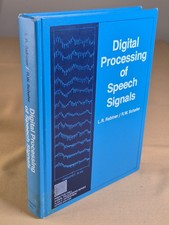
Digital Processing of Speech Signals by L.R. Rabiner and R.W. Schafer
Prentice-Hall, 1978, 0132136031, Hardcover without dust jacket, Ex-library, Good condition, library stamps on endpapers, no underlining, no highlighting, 512 pages.
Prentice-Hall Signal Processing Series, Alan V. Oppenheim. Series Editor
Preface
This book is an outgrowth of an association between the authors which started as fellow graduate students at MIT, was nurtured by a close collaboration at Bell Laboratories for slightly over 6 years, and has continued ever since as colleagues and close friends. The spark which ignited formal work on this book was a tutorial paper on digital representations of speech signals which we prepared for an IEEE Proceedings special issue on Digital Signal Processing, edited by Professor Alan Oppenheim of MIT. At the time we wrote that paper we realized that the field of digital speech processing had matured sufficiently that a book was warranted on the subject.
Once we convinced ourselves that we were both capable of and ready to write such a text, a fundamental question concerning organization had to be resolved. We considered at least 3 distinct ways of organizing such a text and the problem was deciding which, if any, would provide the most cohesive treatment of this field. The 3 organizations considered were
1. According to digital representations
2. According to parameter estimation problems
3. According to individual applications areas.
After much discussion it was felt that the most fundamental notions were those related to digital speech representations and that a sound understanding of such representations would allow the reader both to understand and to advance the methods and techniques for parameter estimation and for designing speech processing systems. ...
CONTENTS
PREFACE
1 INTRODUCTION
1.0 Purpose of This Book 1
1.1 The Speech Signal 1
1.2 Signal Processing 3
1.3 Digital Signal Processing 4
1.4 Digital Speech Processing 5
1.4.1 Digital Transmission and Storage of Speech 7
1.4.2 Speech Synthesis Systems 7
1.4.3 Speaker Verification and Identification 7
1.4.4 Speech Recognition Systems 7
1.4.5 Aids-to-the-Handicapped 8
1.4.6 Enhancement of Signal Quality 8
1.5 Summary 8
References 9
2 FUNDAMENTALS OF DIGITAL SPEECH PROCESSING
2.0 Introduction 10
2.1 Discrete-Time Signals and Systems 10
2.2 Transform Representation of Signals and Systems 13
2.2.1 The z-Transform 13
2.2.2 The Fourier Transform 15
2.2.3 The Discrete Fourier Transform 16
2.3 Fundamentals of Digital Filters 18
2.3.1 FIR Systems 20
2.3.2 IIR Systems 21
2.4 Sampling 24
2.4.1 The Sampling Theorem 24
2.4.2 Decimation and Interpolation of Sampled Waveforms 26
2.5 Summary 31
References 31
Problems 32
3 DIGITAL MODELS FOR THE SPEECH SIGNAL
3.0 Introduction 38
3.1 The Process of Speech Production 38
3.1.1 The Mechanism of Speech Production 39
3.1.2 Acoustic Phonetics 42
3.2 The Acoustic Theory of Speech Production 52
3.2.1 Sound Propagation 56
3.2.2 Example: Uniform Lossless Tube 62
3.2.3 Effects of Losses in the Vocal Tract 66
3.2.4 Effects of Radiation at the Lips 71
3.2.5 Vocal Tract Transfer Functions for Vowels 74
3.2.6 The Effect of Nasal Coupling 76
3.2.7 Excitation of Sound in the Vocal Tract 78
3.2.8 Models Based upon the Acoustic Theory 82
3.3 Lossless Tube Models 82
3.3.1 Wave Propagation in Concatenated Lossless Tubes 83
3.3.2. Boundary. Conditions 85
3.3.3 Relationship to Digital Filters 88
3.3.4 Transfer Function of the Lossless Tube Model 92
3.4 Digital Models for Speech Signals 98
3.4.1 Vocal Tract 99
3.4.2 Radiation 102
3.4.3 Excitation 102
3.4.4 The Complete Model 103
3.5 Summary 105 References 106
Problems 109
4 TIME-DOMAIN MODELS FOR SPEECH PROCESSING
4.0 Introduction 116
4.1 Time-Dependent Processing of Speech 117
4.2 Short-Time Energy and Average Magnitude 120
4.3 Short-Time Average Zero-Crossing. Rate 127
4.4 Speech vs. Silence Discrimination Using Energy and Zero-Crossings 130
4.5 Pitch Period Estimation Using a Parallel Processing Approach 135
4.6 The Short-Time Autocorrelation Function 141
4.7 The Short-Time Average Magnitude Difference Function 149
4.8 Pitch Period Estimation Using the Autocorrelation Function 150
4.9 Median Smoothing and Speech Processing 158
4.10 Summary 161
Appendix 162
References 164
Problems 166
5 DIGITAL REPRESENTATIONS OF THE SPEECH WAVEFORM
5.0 Introduction 172
5.1 Sampling Speech Signals 173
5.2 Review of the Statistical Model for Speech 174
5.3 Instantaneous Quantization 179
5.3.1 Uniform Quantization 181
5.3.2 Instantaneous Companding 186
5.3.3 Quantization for Optimum SNR 191
5.4 Adaptive Quantization 195
5.4.1 Feed-Forward Adaptation 199
5.4.2 response Adaptation 203
5.4.3 General Comments on Adaptive Quantization 207
5.5 General Theory of Differential Quantization 208
5.6 Delta Modulation 216
5.6.1 Linear Delta Modulation 216
5.6.2 Adaptive Delta Modulation 221
5.6.3 Higher-Order Predictors in Delta Modulation 224
5.7 Differential PCM (DPCM) 225
5.7.1 DPCM with Adaptive Quantization 226
5.7.2 DPCM with Adaptive Prediction 228
5.8 Comparison of Systems 232
5.9 Direct Digital Code Conversion 235
5.9.1 LDM-to-PCM Conversion 236
5.9.2 PCM-to-ADPCM Conversion 237
5.10 Summary 238
References 238
Problems 241
6 SHORT-TIME FOURIER ANALYSIS
6.0 Introduction 250
6.1 Definitions and Properties 251
6.1.1 Fourier Transform Interpretation 252
6.1.2 Linear Filtering Interpretation 261
6.1.3 Sampling Rates of X (e^jw) in Time and Frequency 263
6.1.4 Filter Bank Summation Method of Short-Time Synthesis 266
6.1.5 Overlap Addition Method for Short-Time Synthesis 274
6.1.6 Effects of Modifications to the Short-Time Spectrum on the Resulting Synthesis 277
6.1.7 Additive Modifications 280
6.1.8 Summary of the Basic Model for Short-Time Analysis and Synthesis of Speech 281
6.2 Design of Digital Filter Banks 282
6.2.1 Practical Considerations 282
6.2.2 Filter Bank Design Using IIR Filters 290
6.2.3 Filter Bank Design Using FIR Filters 292
6.3 Implementation of the Filter Bank Summation Method Using the Fast Fourier Transform 303
6.3.1 Analysis Techniques 303
6.3.2 Synthesis Techniques 306
6.4 Spectrographic Displays 310
6.5 Pitch Detection 314
6.6 Analysis-by-Synthesis 318
6.6.1 Pitch Synchronous Spectrum Analysis 319
6.6.2 Pole-Zero Analysis Using Analysis-by-Synthesis 321
6.6.3 Pitch Synchronous Estimation of the Glottal Wave 322
6.7 Analysis-Synthesis Systems 324
6.7.1 Digital Coding of the Time-Dependent Fourier Transform 324
6.7.2 The Phase Vocoder 334
6.7.3 The Channel Vocoder 341
6.8 Summary 344
References 344
Problems 347
7 HOMOMORPHIC SPEECH PROCESSING
7.0 Introduction 355
7.1 Homomorphic Systems for Convolution 356
7.1.1 Properties of the Complex Cepstrum 360
7.1.2 Computational Considerations 363
7.2 The Complex Cepstrum of Speech 365
7.3 Pitch Detection 372
7.4 Formant Estimation 378
7.5 The Homomorphic Vocoder 385
7.6 Summary 390
References 390
Problems 391
8 LINEAR PREDICTIVE CODING OF SPEECH
8.0 Introduction 396
8.1 Basic Principles of Linear Predictive Analysis 398
8.1.1 The Autocorrelation Method 401
8.1.2 The Covariance Method 403
8.1.3 Summary 404
8.2 Computation of the Gain for the Model 404
8.3 Solution of the LPC Equations 407
8.3.1 Cholesky Decomposition Solution for the Covariance Method 407
8.3.2 Durbin\'s Recursive Solution for the Autocorrelation Equations 411
8.3.3 Lattice Formulations and Solutions 413
8.4 Comparisons Between the Methods of Solution of the LPC Analysis Equations 417
8.5 The Prediction Error Signal 421
8.5.1 Alternate Expressions for the Normalized Mean-Squared Error 424
8.5.2 Experimental Evaluation of Values for the LPC Parameters 426
8.5.3 Variations of the Normalized Error with Frame Position 429
8.6 Frequency Domain Interpretation of Linear Predictive, Analysis 431
8.6.1 Frequency Domain Interpretation of Mean-Squared Prediction Error 433
8.6.2 Comparison to Other Spectrum Analysis Methods 436
8.6.3 Selective Linear Prediction 438
8.6.4 Comparison to Analysis-by-Synthesis Methods 439
8.7 Relation of Linear Predictive Analysis to Lossless Tube Models 440
8.8 Relations Between the Various Speech Parameters 441
8.8.1 Roots of the Predictor Polynomial 442
8.8.2 Cepstrum 442
8.8.3 Impulse Response of the All-Pole System 442
8.8.4 Autocorrelation of the Impulse Response 443
8.8.5 Autocorrelation Coefficients of the Predictor Polynomial 443
8.8.6 PARCOR Coefficients 443
8.8.7 Log Area Ratio Coefficients 444
8.9 Synthesis of Speech from Linear Predictive Parameters 444
8.10 Applications of LPC Parameters 447
8.10.1 Pitch Detection Using LPC Parameters 447
8.10.2 Formant Analysis Using LPC Parameters 450
8.10.3 An LPC Vocoder—Quantization Considerations 451
8.10.4 Voiced-Excited LPC Vocoders 452
8.11 Summary 453
References 454
Problems 455
9 DIGITAL SPEECH PROCESSING FOR MAN-MACHINE COMMUNICATION BY VOICE
9.0 Introduction 462
9.1 Voice Response Systems 464
9.1.1 General Considerations in the Design of Voice Response Systems 466
\' 9.1.2 A Multiple-Output Digital Voice Response System 469
9.1.3 Speech Synthesis by Concatenation of Formant-Coded Words 470
9.1.4 Typical Applications of Computer Voice Response Systems 473
9.2 Speaker Recognition Systems 476
9.2.1 Speaker Verification Systems 478
9.2.2 Speaker Identification Systems 485
9.3 Speech Recognition Systems 489
9.3.1 Isolated Digit Recognition. System 490
9.3.2 Continuous Digit Recognition System 494
9.3.3 LPC Distance Measures 498
9.3.4 Large Vocabulary Word Recognition System 500
9.4 A 3-Mode Speech Communication System 502
9.5 Summary 503
References 503
PROJECTS
(i) Literature Survey and Report 506
(ii) Hardware Design Project 507
(iii) Computer Project 508
INDEX
nthdegree books
When you click on links to various merchants on this site and make a purchase, this can result in this site earning a commission. Affiliate programs and affiliations include, but are not limited to, the eBay Partner Network.

 Digital Processing of Speech Signals$11.70
 Digital Speech Processing (Signal Processing and Communications)by Sadaoki Furui$189.00
 The Digital Signal Processing Handbook: Video, Speech, and Audio Signal...$68.48
 Automatic Speech Recognition: A Deep Learning Approach (Signals and Communic...$31.51
 Digital Processing of Speech Signals Ronald, Rabiner, Lawrence Sc$7.00
 Digital Processing of Speech Signals by Rabiner, Lawrence; Schafer, Ronald$8.00
 THEORY AND APPLICATIONS OF DIGITAL SPEECH PROCESSING By Lawrence Rabiner$28.00
 Digital Processing of Speech Signals - L.R. Rabiner & R.W.Schafer, Prentice-Hall$19.95
 www.userbars.org














