The Nile on
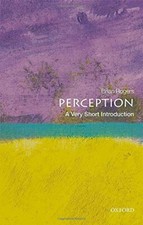
Perception by Brian Rogers
Brian J. Rogers analyses the psychological and philosophical aspects of perception, and argues that what we see is not what we perceive. He investigates recent insights gained from the use of imaging techniques, and the attempts to model perceptual processes in AI systems.
FORMAT
Paperback LANGUAGE
English CONDITION
Brand New Publisher Description
Perception is one of the oldest and most deeply investigated topics in the field of psychology, and it is also raises some profound philosophical questions. It is concerned with how we use the information reaching our senses to guide and control our behaviour as well as to create our particular, subjective experiences of the surrounding this Very Short Introduction, Brian J. Rogers discusses the philosophical question ofwhat it means to perceive, as well as describing how we are able to perceive the particular characteristics of objects and scenes such as their lightness, colour, form, depth, and motion. What we perceive,however, does not always correspond to what exists in the world and, as Rogers shows, the study of illusions can be useful in telling us something about the nature and limitations of our perceptual processes. Rogers also explores perception from an evolutionary perspective, explaining how evolutionary pressures have shaped the perceptual systems of humans and other animals. He shows that perception is not necessarily a separate and independent process but rather part of a 'perceptual system',involving both the extraction of perceptual information and the control of action. Rogers goes on to cover the significant progress made recently in the understanding of perception through the use ofprecise and controlled psychophysical methods, single cell recordings, and imaging techniques. There have also been many insights from attempts to model perceptual processes in artificial systems. As Rogers shows, these attempts have revealed how difficult it is to programme machines to perform even the most simple of perceptual tasks that we take for THE SERIES: The Very Short Introductions series from Oxford University Press contains hundreds oftitles in almost every subject area. These pocket-sized books are the perfect way to get ahead in a new subject quickly. Our expert authors combine facts, analysis, perspective, new ideas, and enthusiasm tomake interesting and challenging topics highly readable.
Table of Contents
1: What is perception? 2: Perceptual theories - indirect, direct and computational. 3: Lightness and colour 4: Motion perception 5: Perception of a 3-D world 6: Perception and action 7: Delusions about illusions 8: The physiology and anatomy of the perceptual system 9: The future Glossary Further Reading Index
Review
A compact, accessible and engaging tour of vision and perception, covering all the essentials and challenging the current understanding of visual illusions. * Professor Patrick Cavanagh, Harvard University *
The perfect little book to polish off one's education. Understanding the language of perception is a proper part of the urban intellectual's baggage. * Jan Koenderink, Utrecht University *
Long Description
Perception is one of the oldest and most deeply investigated topics in the field of psychology, and it is also raises some profound philosophical questions. It is concerned with how we use the information reaching our senses to guide and control our behaviour as well as to create our particular, subjective experiences of the surrounding this Very Short Introduction, Brian J. Rogers discusses the philosophical question of what it means to perceive, as well as describing how we are able to perceive the particular characteristics of objects and scenes such as their lightness, colour, form, depth, and motion. What we perceive, however, does not always correspond to what exists in the world and, as Rogers shows, the study of illusions can be useful in telling us something about the nature and limitations of ourperceptual processes. Rogers also explores perception from an evolutionary perspective, explaining how evolutionary pressures have shaped the perceptual systems of humans and other animals. He shows that perception is not necessarily a separate and independent process but rather part of a 'perceptual system',involving both the extraction of perceptual information and the control of action. Rogers goes on to cover the significant progress made recently in the understanding of perception through the use of precise and controlled psychophysical methods, single cell recordings, and imaging techniques. There have also been many insights from attempts to model perceptual processes in artificial systems. As Rogers shows, these attempts have revealed how difficult it is to programme machines to performeven the most simple of perceptual tasks that we take for THE SERIES: The Very Short Introductions series from Oxford University Press contains hundreds of titles in almost every subject area. These pocket-sized books are the perfect way to get ahead in a new subject quickly. Our expert authors combine facts, analysis, perspective, new ideas, and enthusiasm to make interesting and challenging topics highly readable.
Review Quote
A compact, accessible and engaging tour of vision and perception, covering all the essentials and challenging the current understanding of visual illusions.
Feature
Discusses the philosophical question of what it means to perceive, as well as describing how we are able to perceive the particular characteristics of objects and scenes such as their lightness, colour, form, depth and motionConsiders how evolutionary pressures have shaped the perceptual systems of both humans and other animalsDiscusses recent advances in understanding perception, and analyzes attempts to program machines to perform perceptive tasksPart of the Very Short Introductions series - over eight million copies sold worldwide
Details ISBN0198791003 Series Very Short Introductions Language English Year 2017 ISBN-10 0198791003 ISBN-13 9780198791003 Format Paperback Publisher Oxford University Press Author Brian Rogers Imprint Oxford University Press Place of Publication Oxford Country of Publication United Kingdom DEWEY 153.7 Affiliation Emeritus Research Zoologist, Smithsonian Conservation Biology Institute, Smithsonian Institution Media Book Publication Date 2017-10-26 UK Release Date 2017-10-26 NZ Release Date 2017-10-26 Illustrations 54 black and white images Pages 192 Illustrator Tim Archbold Birth 1962 Position Emeritus Research Zoologist Qualifications MD Audience General AU Release Date 2017-11-08 Subtitle A Very Short Introduction Country of Origin GB Product Class Description Psychology: Professional & General
We\'ve got this
At The Nile, if you\'re looking for it, we\'ve got it.
With fast shipping, low prices, friendly service and well over a million items - you\'re bound to find what you want, at a price you\'ll love!
TheNile_Item_ID:117017063;
When you click on links to various merchants on this site and make a purchase, this can result in this site earning a commission. Affiliate programs and affiliations include, but are not limited to, the eBay Partner Network.

 Perception: A Very Short Introduction - Paperback, by Rogers Brian - Very Good$7.39
 Brian Rogers Perception (Paperback) Very Short Introductions$16.17
 Brian Rogers Perception (Paperback) Very Short Introductions (UK IMPORT)$17.15
 Perception: A Very Short Introduction$17.12
 Perception: A Very Short Introduction$10.50
 Perception: A Very Short Introduction$5.91
 Perception : A Very Short Introduction, Paperback by Rogers, Brian, Brand New...$14.92
 Perception: A Very Short Introduction (Very Short Introductions), Rogers..$17.76
 www.userbars.org














