The Nile on
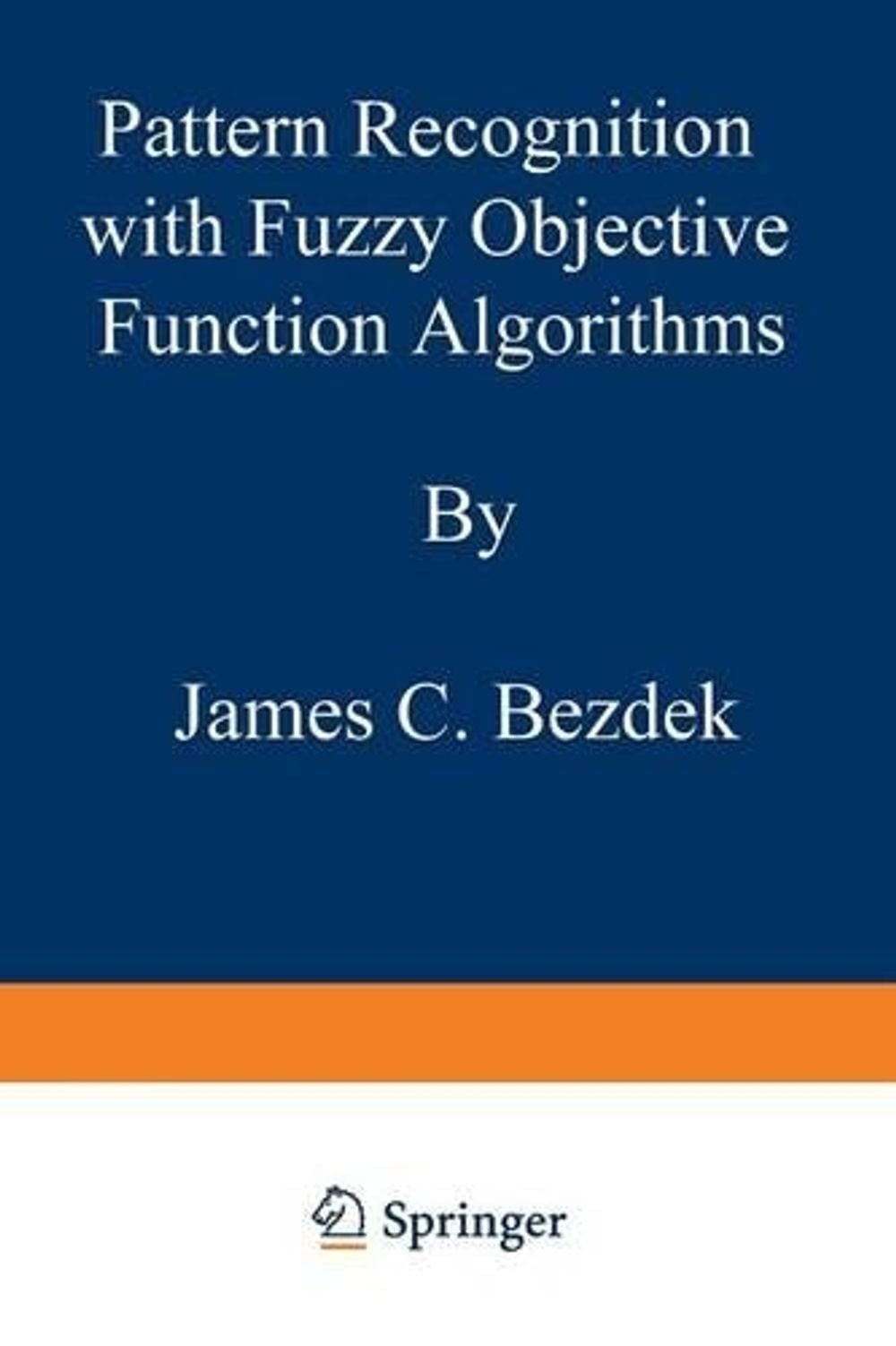
Pattern Recognition with Fuzzy Objective Function Algorithms by James C. Bezdek
It was not until 1973, however, when the appearance of the work by Dunn and Bezdek on the Fuzzy ISODATA (or fuzzy c-means) algorithms became a landmark in the theory of cluster analysis, that the relevance of the theory of fuzzy sets to cluster analysis and pattern recognition became clearly established.
FORMAT
Paperback LANGUAGE
English CONDITION
Brand New Publisher Description
The fuzzy set was conceived as a result of an attempt to come to grips with the problem of pattern recognition in the context of imprecisely defined categories. In such cases, the belonging of an object to a class is a matter of degree, as is the question of whether or not a group of objects form a cluster. A pioneering application of the theory of fuzzy sets to cluster analysis was made in 1969 by Ruspini. It was not until 1973, however, when the appearance of the work by Dunn and Bezdek on the Fuzzy ISODATA (or fuzzy c-means) algorithms became a landmark in the theory of cluster analysis, that the relevance of the theory of fuzzy sets to cluster analysis and pattern recognition became clearly established. Since then, the theory of fuzzy clustering has developed rapidly and fruitfully, with the author of the present monograph contributing a major share of what we know today. In their seminal work, Bezdek and Dunn have introduced the basic idea of determining the fuzzy clusters by minimizing an appropriately defined functional, and have derived iterative algorithms for computing the membership functions for the clusters in question. The important issue of convergence of such algorithms has become much better understood as a result of recent work which is described in the monograph.
Table of Contents
1. Models for Pattern Recognition.- S1 Pattern Recognition.- S2 Some Notes on Mathematical Models.- S3 Uncertainty.- 2. Partitions and Relations.- S4 The Algebra of Fuzzy Sets.- S5 Fuzzy Partition Spaces.- S6 Properties of Fuzzy Partition Spaces.- S7 Fuzzy Relations.- 3. Objective Function Clustering.- S8 Cluster Analysis: An Overview.- S9 Density Functionals.- S10 Likelihood Functionals: Congenital Heart Disease.- S11 Least-Squares Functionals: Fuzzy c-Means.- S12 Descent and Convergence of Fuzzy c-Means.- S13 Feature Selection for Binary Data: Important Medical Symptoms.- 4. Cluster Validity.- S14 Cluster Validity: An Overview.- S15 The Partition Coefficient: Numerical Taxonomy.- S16 Classification Entropy.- S17 The Proportion Exponent: Numerical Taxonomy Revisited.- S18 Normalization and Standardization of Validity Functionals.- S19 The Separation Coefficient: Star-Tracker Systems.- S20 Separation Indices and Fuzzy c-Means.- 5. Modified Objective Function Algorithms.- S21 Affinity Decomposition: An Induced Fuzzy Partitioning Approach.- S22 Shape Descriptions with Fuzzy Covariance Matrices.- S23 The Fuzzy c-Varieties Clustering Algorithms.- S24 Convex Combinations: Fuzzy c-Elliptotypes.- 6. Selected Applications in Classifier Design.- S25 An Overview of Classifier Design: Bayesian Classifiers.- S26 A Heuristic Approach to Parametric Estimation: Bayesian Classifiers for Mixed Normal Distributions.- S27 Nearest Prototype Classifiers: Diagnosis of Stomach Disease.- S28 Fuzzy Classification with Nearest Memberships.- References.- Algorithm Index.- Author Index.
Promotional
Springer Book Archives
Long Description
The fuzzy set was conceived as a result of an attempt to come to grips with the problem of pattern recognition in the context of imprecisely defined categories. In such cases, the belonging of an object to a class is a matter of degree, as is the question of whether or not a group of objects form a cluster. A pioneering application of the theory of fuzzy sets to cluster analysis was made in 1969 by Ruspini. It was not until 1973, however, when the appearance of the work by Dunn and Bezdek on the Fuzzy ISODATA (or fuzzy c-means) algorithms became a landmark in the theory of cluster analysis, that the relevance of the theory of fuzzy sets to cluster analysis and pattern recognition became clearly established. Since then, the theory of fuzzy clustering has developed rapidly and fruitfully, with the author of the present monograph contributing a major share of what we know today. In their seminal work, Bezdek and Dunn have introduced the basic idea of determining the fuzzy clusters by minimizing an appropriately defined functional, and have derived iterative algorithms for computing the membership functions for the clusters in question. The important issue of convergence of such algorithms has become much better understood as a result of recent work which is described in the monograph.
Details ISBN1475704526 Author James C. Bezdek Short Title PATTERN RECOGNITION W/FUZZY OB Language English ISBN-10 1475704526 ISBN-13 9781475704525 Media Book Format Paperback DEWEY 001.534 Residence US Birth 1939 Year 2012 Publication Date 2012-05-20 Imprint Springer-Verlag New York Inc. Place of Publication New York, NY Country of Publication United States Pages 272 Series Advanced Applications in Pattern Recognition Illustrations 272 p. DOI 10.1007/978-1-4757-0450-1 AU Release Date 2012-05-20 NZ Release Date 2012-05-20 US Release Date 2012-05-20 UK Release Date 2012-05-20 Publisher Springer-Verlag New York Inc. Edition Description Softcover reprint of the original 1st ed. 1981 Alternative 9780306406713 Audience Professional & Vocational Country of Origin NL Product Class Description Mathematics
We\'ve got this
At The Nile, if you\'re looking for it, we\'ve got it.
With fast shipping, low prices, friendly service and well over a million items - you\'re bound to find what you want, at a price you\'ll love!
TheNile_Item_ID:96394737;
When you click on links to various merchants on this site and make a purchase, this can result in this site earning a commission. Affiliate programs and affiliations include, but are not limited to, the eBay Partner Network.

 Fuzzy Models for Pattern Recognition by James C. Bezdek - Hardcover - GOOD$9.99
 Pattern Recognition With Fuzzy Objective Function Algorithms by Bezdek - HC/DJ$35.00
 J. C. BEZDEK - Pattern Recognition with Fuzzy Objective Function | MINT$119.99
 SHIGEO ABE - Pattern Recognition: Neuro-Fuzzy Methods and Their Comparison | NEW$169.99
 Fuzzy Models for Pattern Recognition: Methods That Search for Structures in ...$9.40
 Neuro-Fuzzy Pattern Recognition : Methods in Soft Computing Hardc$21.44
 Neuro-Fuzzy Pattern Recognition: - Hardcover, by Pal Sankar K.; - Very Good$23.79
 Fuzzy Models for Pattern Recognition: Methods That Search for Structures in...$15.19
 www.userbars.org